About the author
Anna Röll

The difference between sexually transmitted infections (STIs) and sexually transmitted diseases (STDs) is important to improve understanding of these health risks: Sexually transmitted infections include all infections transmitted through sexual contact, even if they do not cause symptoms. A sexually transmitted disease is diagnosed only when the infection causes symptoms and signs of illness. The term "STI" is broader and increasingly used because many infections remain asymptomatic but are still contagious. This knowledge helps enable earlier diagnosis and treatment and prevents the spread of undetected infections.
An infection refers to the entry and multiplication of pathogens (e.g., bacteria, viruses, fungi, or parasites) in the body. This activates the immune system, often without visible symptoms. A disease occurs when this infection disrupts the body’s balance and causes visible symptoms or functional disorders ( Cleveland Clinic, 2022).
The correct terms are STI (sexually transmitted infection) and STD (sexually transmitted disease). A sexually transmitted infection (STI) occurs when pathogens enter the body through sexual contact (oral, anal, vaginal) and multiply there. An STI may cause no symptoms and can go unnoticed but can still be transmitted to others and lead to long-term health issues and complications.
A sexually transmitted disease (STD) is an advanced form of an STI. It develops when the infection causes symptoms and burdens the body to the point of noticeable illness, such as pain or discharge. While every STD stems from an STI, not every STI necessarily progresses to an STD (CDC, 2024).
HPV (Human Papillomavirus) clearly illustrates the difference between an STI and an STD. Many people – about 80% of sexually active individuals – become infected with HPV without ever noticing symptoms. In these cases, HPV remains a silent infection (STI), which disappears on its own in 90% of cases. However, in some individuals, the infection develops into a disease (STD), presenting as genital warts or – in rare cases – cancer, such as cervical cancer, if the infection persists long-term. HPV thus shows that an STI does not necessarily lead to an STD; this depends in part on the individual's immune response and the virus type (NHS, 2022).
The term STI is used more frequently today because it more accurately describes that many sexually transmitted infections progress without symptoms and do not cause visible diseases (STDs). The term emphasizes that infections can exist and be transmitted without any symptoms, yet still require treatment. As such, the use of "STI" promotes greater awareness for prevention and the importance of regular health checks even in the absence of symptoms (Cleveland Clinic, 2022).
The most common sexually transmitted infections, caused by various pathogens, include:
| Pathogen type | Infection (pathogen name) |
|---|---|
| Bacteria |
Chlamydia (Chlamydia trachomatis) Gonorrhoea (Neisseria gonorrhoeae) Syphilis (Treponema pallidum) |
| Viruses |
HPV (Human papillomavirus) Herpes simplex (Herpes simplex virus) HIV (Human immunodeficiency virus) |
| Parasites | Trichomoniasis (Trichomonas vaginalis) |
Source: WHO, 2024
Some sexually transmitted infections (STIs), if left untreated, frequently develop into sexually transmitted diseases (STDs) with potentially serious health consequences. These include:
HPV (Human papillomavirus): Certain HPV types can cause genital warts or increase the long-term risk of cancers, such as cervical cancer.
HIV: Without treatment, HIV progresses to AIDS, which severely weakens the immune system and increases vulnerability to infections and certain cancers.
Syphilis: If untreated, syphilis can lead to severe organ damage and neurological problems in its later stages.
Gonorrhoea: If untreated, gonorrhoea can spread throughout the body, leading to infertility and chronic pelvic inflammation.
Hepatitis B: This infection can become chronic and lead to liver cirrhosis or liver cancer.
STIs require early detection and treatment to prevent progression to STD and avoid potential long-term damage (Cleveland Clinic, 2022).
Symptoms of STIs and STDs can vary widely depending on the pathogen, but common signs include:
Unusual discharge from the penis, vagina, or anus (cloudy, pus-like, or foul-smelling)
Pain or burning during urination, frequent urination
Itching or redness in the genital area
Mild lower abdominal pain or pelvic pressure
Mild rashes or blisters in the genital, anal, or oral area (e.g., herpes)
Irregular bleeding outside menstruation (in women)
Severe symptoms of untreated STIs include chronic pelvic pain, significant swelling in the groin, widespread rashes (e.g., syphilis), jaundice (hepatitis B), and genital ulcers. Advanced HIV infections often lead to extreme fatigue, night sweats, and severe immune deficiency, increasing the risk of serious infections and cancers (Medline Plus, 2024).
STIs are diagnosed through specific tests that vary depending on the infection type. These include:
Blood tests (e.g., for HIV, syphilis, hepatitis)
Swabs (e.g., for HPV or herpes) from genital, throat, or anal areas
Physical examinations to detect symptoms such as rashes or ulcers
Regular screenings are especially important, as many STIs remain asymptomatic. In Germany, these tests can be conducted by general practitioners, gynecologists, urologists, or public health offices. Alternatively, home testing kits are available (Medline Plus, 2024).
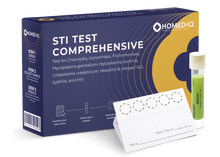
Regular STI testing is particularly important for people with multiple sexual partners, new relationships, or after unprotected sex. These tests are the safest way to detect infections that often occur without symptoms and to prevent long-term effects and unintentional transmission. For example, with Homed-IQ, you can test yourself for many common sexually transmitted infections using the complete STI test or test for specific STIs such as the HPV test for women or the chlamydia test — all conveniently from home.
Treatment of a sexually transmitted infection or disease depends on the pathogen:
Bacterial STIs (e.g., chlamydia, gonorrhoea, syphilis): Usually treated successfully with antibiotics. Consistent use is essential to fully eliminate the infection and prevent resistance. Sexual partners should be informed and treated as well to avoid reinfection, and sexual contact should be avoided during treatment.
Viral STIs (e.g., herpes, HPV, HIV): Antiviral medications are used to reduce viral load and relieve symptoms. Herpes outbreaks can be controlled, and transmission reduced. HIV requires lifelong therapy to suppress the virus, slow disease progression, and minimize transmission risk. A complete cure is generally not possible for most viral STIs.
Parasitic STIs (e.g., trichomoniasis): Treated with antiparasitic medications to eliminate the parasite.
Source: WHO, 2024
Sexually transmitted infections (STIs) and sexually transmitted diseases (STDs) differ in whether an infection causes symptoms. An STI occurs when pathogens enter and multiply in the body — often without symptoms. A condition is classified as an STD when the infection visibly affects the body. Since many STIs remain asymptomatic, the term is increasingly used to emphasize the importance of prevention and regular health screenings.
At-home testing with laboratory accuracy
Our medical laboratories operate according to strict European quality standards. All tests are analysed by ISO-certified partner labs, giving you reliable and professional results. With the comfort of your home.